'Slow is wrong' - Hiding normative structure
Next week I am on a panel at Black Tech Fest and received this encouragement to sign up for one of the workshops. The wording was striking. Unpacking follows.
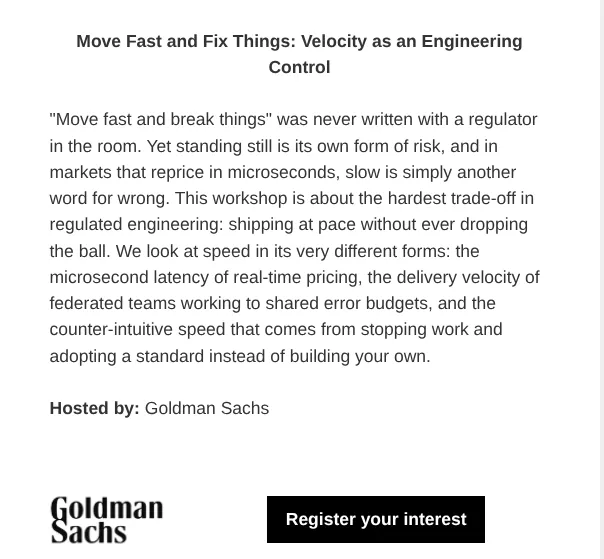
The claim I want to focus on is:
Yet standing still is its own form of risk, and in markets which reprice in microseconds, slow is simply another word for wrong.
In this context 'wrong' has a very special meaning. It refers to a missed opportunity to make money by trading in the market being considered. Missing opportunities is not, in general, wrong. The use of that term here only makes sense because it is assumed that the function of Goldman Sachs as an institution to make money by trading in these markets. That is why such financial institutions exist at all, you might think. By missing opportunities, they are performing that function less well and perhaps falling behind.
How Fast Trading Makes More Money
The facts of the situation are this. There is a market in some financial asset or derivative therefrom, and the price continuously changes over time. Traders attempt to predict those changes and buy, sell or hold the asset in line with those predictions and where those predictions are consistently above chance they will make money by so doing.
Suppose the time sequence of prices changes is < t0, t1, t2, ... , tn>, maybe incrementing in "microseconds". What is the benefit to a trader in making a trading decision at each and every step in the sequence, i.e. moving fast, rather than at t0, t10, t20 etc.?1
Suppose you trade slowly, then the maximum growth of your investment you can achieve is the increase in price of the asset between t0 and t10. Suppose instead you trade fast, making at decision at each of t0, t1, t2 etc., then there are two ways you will likely make more money than slow trader.
Firstly, if the value of the asset fluctuates between t0 and t10, then by correctly predicting these fluctuations, you will get the cumulative effect of the increases rather than merely the value at t10. For example, if the value of the asset goes up by 10% at t1, drops back to its original value at t2, goes up by 10% at t3, drops back at t4, etc. Then at t10 the value of the asset will be the same as it was at t0. The slow trader will have made no money. However, the fast trader, if they correctly predict these fluctuations and buy and sell accordingly, will have a profit of at least 50%.
Secondly, there will be a compound interest effect. Each time a trader sells at a peak, they give themselves more capital to invest at the next trough, and thus a greater return at the next peak.
So slow simply is another word for wrong?
The point of this rather plodding and oversimplified explanation of why fast trading has the potential to create greater profits than slow trading was to show that the structure of the situation is completely neutral on what is being traded. In fact, there doesn't even need to be an asset being traded at all, just a potential profit depending upon the accuracy of a prediction. For example, betting on a cricket match ball by ball has the potential to create much greater profits for those who predict accurately than betting on the outcome of the match, even if the odds offered in each case are very similar.
All this, so far, will be familiar to many people. The reason for labouring it is the very striking use of a normative term "wrong" in the Goldman Sachs statement, while not indicating that there may be relevant normative distinctions between, for example, investing and betting.
The point or purpose of playing cricket is to win the match. Some people may engage in the activity because it gives them pleasure whether they win or lose, but it is internal to the activity that one is trying to win. All that matters for success rather than enjoyment is the final score. All the steps in the process which produce that project, diligently recorded in the Scorekeeper's scorebook, are merely a means to that end. Of course it's possible to care a lot about each of those steps and even to bet upon them, but this is secondary to, or derivative from, the primary activity which is trying to win.
The reference to markets in the claim Goldman Sachs is making that slow is wrong obfuscates the distinction between the primary activity and its point and success against those objectives and secondary or derivative activities. The primary activity of the markets, whether these are stock markets, private equity, bond markets, mortgages, personal loans, is to move money from investors, i.e. those institutions or individuals who have more cash than they need to meet their expenses, to those businesses, institutions and people who have less cash than they need to meet their current spending objectives. It is a market because investors seek to make a profit in return for lending their cash, and the market prices the loans.
It should be obvious that this primary activity is always a slow trade. When a business issues shares or bonds, they are offering their investors a return over a period of usually several years. When an individual takes out a mortgage or a loan, they are also offering the borrower a return over several years. Such trades are supervenient on the daily, let alone microsecond, fluctuations in price, in the way that winning a cricket match is supervenient on the ball by ball events.
From the point of view of this primary activity of the markets, there is absolutely nothing wrong with missing the opportunity to trade on moment by moment fluctuations in market price. In fact, those receiving the money in this transaction are usually bound by contractual clauses which have significant financial penalties, disincentivising any change in response to those fluctuations in market price.
Fast trading is not inherently good
If what I've argued so far is correct, then we can conclude that fast trading only benefits the investors in this primary market. Those entering the primary market in order to seek money for their purposes are looking for slow trades, for fast trades do not benefit them in s in achieving those objectives.
Investors seeking longer term security of return will also be interested in slow trades. Those seeking to maximize return on their investment will be attracted to fast trading because they are willing to take on the associated risk or perhaps have considerable confidence in their ability to predict these fast trades. But the markets which sustain fast trading are necessarily secondary or derivative from the primary markets.
The problem with saying that "slow is wrong" is that were that true, then it would be wrong to engage in the primary market, but without the primary market, the secondary markets can't exist. So, as a maxim, it is self-defeating.
Furthermore, if we accept that, at least given the current global economic order, the primary market is not merely essential but a positively good thing, then to the extent that fast trading weakens the primary market and slow trading fast is wrong. Or perhaps we should say more cautiously that it is something which can be tolerated, like betting on sport, so long as it is carefully regulated so as not to interfere with the functioning of the primary market.
I am going to make the assumption that shorting and other ways of profiting from the decrease in value of an asset should be regarded as trading in a different derivative market.↩